

Introduction
A solar EPC that writes galvanized steel, 25-year life on a tracker RFQ will receive three incomparable offers. One mill quotes continuous EN 10346 ZM coil for C-purlins. One galvanizing shop quotes ISO 1461 after fabrication on welded piles. A third substitutes DX51D+Z because the word galvanized appeared. Yield can match a drawing note. Coating chemistry will not.
This is a duty-path guide for importers who buy tracker steel from China: roll-formed members from coil, and shop-welded piles or brackets that still need a zinc layer after cutting. It is procurement guidance, not a substitute for the ordered edition of EN 10346, ISO 1461, ASTM A123, ASTM A1046, JIS G 3323, or ISO 9223. Brand names such as ZAM, Magnelis, PosMAC, and SuperDyma are mill coatings, not interchangeable grades. Freeze the standard, the coating designation, and the product form before anyone compares FOB numbers.
Classify The Site Before You Name The Coating
Classify the solar site on ISO 9223 first, then split the bill of materials. Roll-formed purlins usually belong on EN 10346 ZM coil. Shop-welded piles and thick brackets usually belong on ISO 1461 or ASTM A123 batch HDG after fabrication. ZM120 is not a substitute for 85 μm post-galvanizing.
ISO 9223 / ISO 12944-2 corrosivity is the duty. The mill already has zinc-coated coil. Batch galvanizing is an extra shop operation after welding. If the RFQ only writes “GI” or “HDG,” bidders can choose materially different coating routes that cannot be compared on price alone.
Walk the site class first, then name the coating family.
| Site class buyers discuss | Typical tracker setting | Coil path buyers freeze | Fabricated-section path buyers freeze |
|---|---|---|---|
| C2–C3 | Inland, low chloride | EN 10346 ZM on structural coil, often ZM120–ZM275 | ISO 1461 or ASTM A123 after fabrication if the part is welded |
| C4 | Industrial belt or coast beyond about 1 km | Raise ZM mass; ZM275–ZM310 is a common RFQ band | Mean coating thickness on the finished thickness, not a coil Z code |
| C5 | Severe coastal, about 150 m class talk | ZM alone is often not a 25-year standalone story | Batch HDG after all cutting and welding, with sealed edges if coil is still used |
Manufacturer design-life tables for one Type 2 Zn-Al-Mg coating (ZM310 / ZM430) are often quoted as C3 30 to >50 years, C4 15–30 years, and C5 8–15 years for ZM310. Those bands are mill data. They are not a generic ZM guarantee and they exclude soil or standing-water contact. Put the project class on the RFQ. Do not let the mill pick C3 from a warehouse photo of a desert site.
A USD 40 per tonne gap on 2.5 mm purlin coil is often this missing class, not ocean freight. Two FOB numbers that both say “galvanized tracker steel” are not comparable if one is ZM120 coil and the other is 85 μm batch HDG on 8 mm pile.
Split Tracker Steel By Form: Roll-Formed Coil Versus Fabricated Section
Product form decides the process. Continuous coating happens on strip before the profiler. Batch HDG happens on the finished part after cutting, punching, and welding.
| Tracker member | Usual form | Coating that belongs | Why a swap fails |
|---|---|---|---|
| C-purlin, U-channel, cold-formed girder | Coil, typically 1.5–3.2 mm | EN 10346 +ZM on a structural grade | Batch HDG after roll-forming is slow, distorts thin gauge, and is the wrong shop |
| Torque tube from strip | Coil or tube from coated strip | ZM coil if the weld is re-protected; HDG if the tube is welded from black steel | A black weld on ZM coil is a bare cut until it is repaired |
| Driven pile, H-pile, thick bracket, shop-welded frame | Plate or section, often ≥6 mm | ISO 1461 or ASTM A123 after fabrication | ZM coil cannot wrap a shop weld; cut edges on thick plate are not a 2 mm self-heal story |
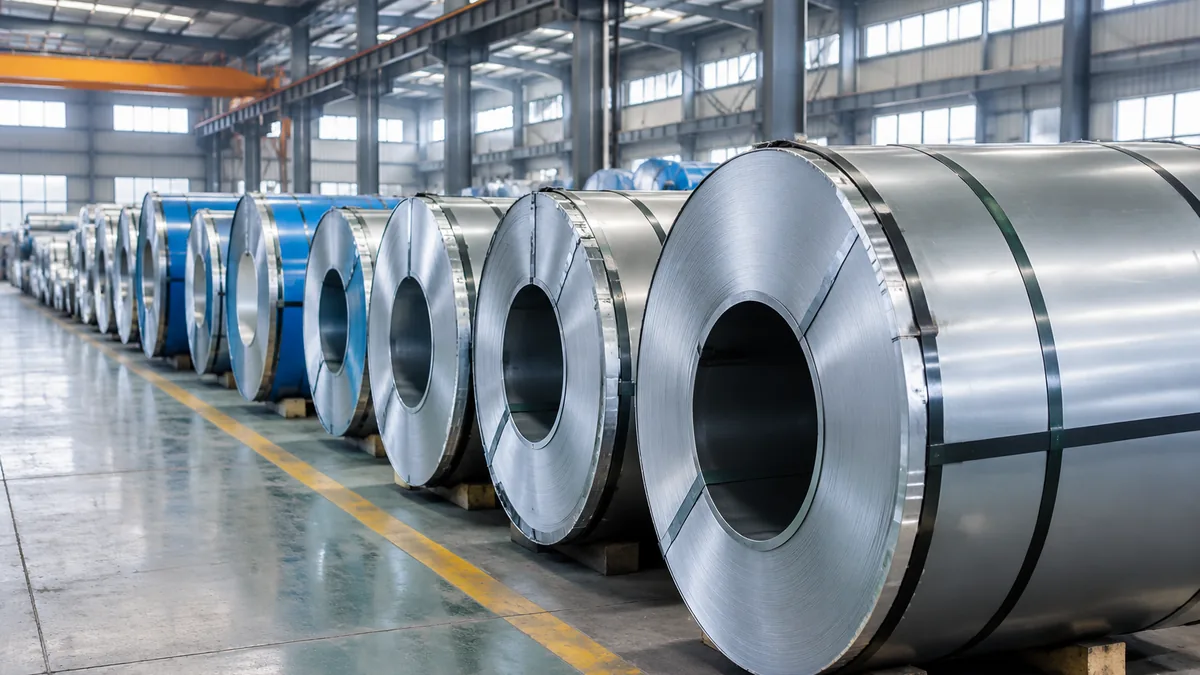
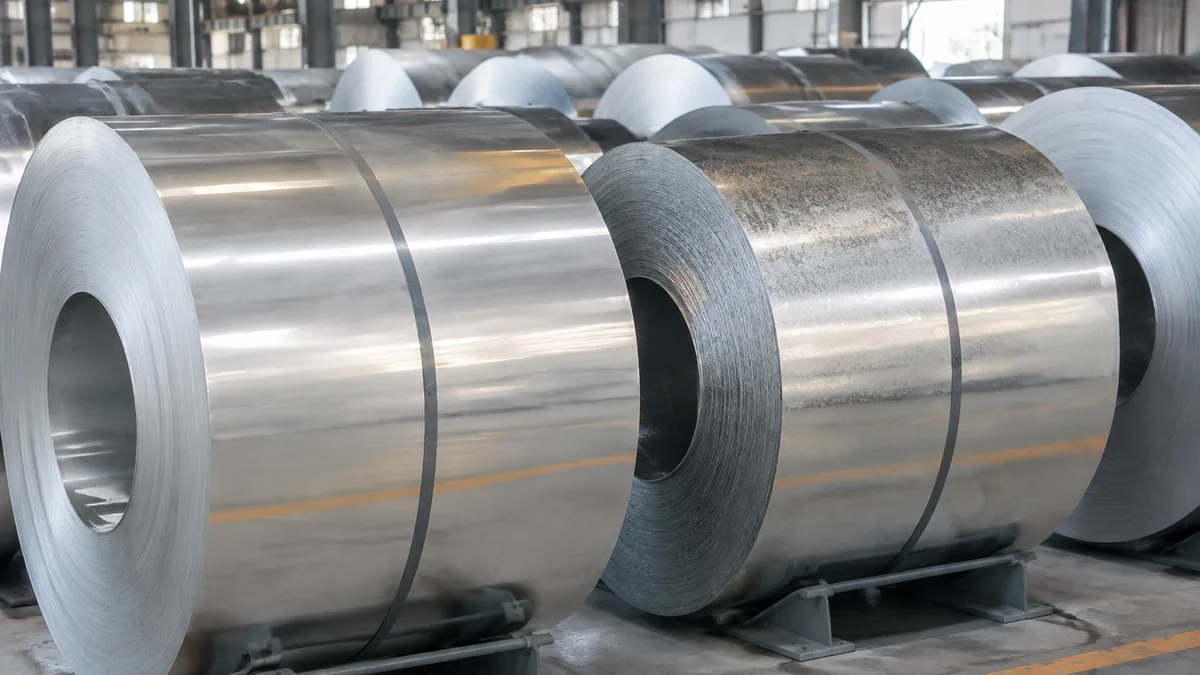
DX51D galvanized coil is a forming-grade continuous zinc product. Tracker purlins that need a yield class should freeze S350GD or S550GD, not a commercial DX51D nickname. G550 galvanized coil is a high-strength zinc coil used on roofing and some cold-formed members; it is still +Z chemistry unless the PO writes +ZM. SGCH full hard galvanized coil is a hard zinc coil, not a tracker structural grade. Galvanized H-beam is the fabricated-section path for piles and frames. Carbon flat steel is the black plate that later goes to the HDG kettle.
Do not mix those five lines into one “GI tracker” cell on the RFQ spreadsheet.
When EN 10346 ZM Coil Fits The Duty
ZM / Zn-Al-Mg is a continuous hot-dip coating. EN 10346 writes it as a ZM mass in g/m², total both sides. ASTM A1046 covers Zn-Al-Mg coated sheet and names coating types; mill brands sit in different types. JIS G 3323 is the Japanese Zn-Al-Mg sheet standard. None of those documents makes two mill baths 100% equivalent.
Typical bath talk, for RFQ language only, not as a heat you already bought:
| Coating family | Governing standard buyers name | Chemistry buyers see on mill sheets | Number that must be printed |
|---|---|---|---|
| Zn-Al-Mg coil | EN 10346 +ZM; ASTM A1046; JIS G 3323 | Zinc with aluminium and magnesium. One Type 2 bath is often described as about 3.5% Al and 3% Mg. Other baths run higher aluminium. | ZM120, ZM275, ZM310, ZM430 as total both-sides mass |
| Continuous zinc coil | EN 10346 +Z; ASTM A653 | Essentially zinc | Z275 as total both-sides mass |
| Batch HDG | ISO 1461; ASTM A123 | Zinc bath, typically high-purity zinc | Mean and local-minimum thickness in μm on the finished part |
Coating density used to convert mass to micrometres is mill-specific. One Type 2 producer publishes 6.2 g/cm³ and lists ZM120 at about 10 μm per side, ZM310 at about 25 μm per side, and ZM430 at about 35 μm per side. Other catalogues use about 6.0 g/cm³. Do not convert a competitor’s ZM310 with a zinc density of 7.1 g/cm³ and call it equal to 85 μm batch HDG.
Substrate chemistry is a separate table. Confirm the ordered edition of EN 10346; these are commonly discussed maxima, not the ladle of the coil on your dock:
| Grade | C % max | Si % max | Mn % max | P % max | S % max | Yield min (MPa) | Tensile min (MPa) | A80 elongation, typical table |
|---|---|---|---|---|---|---|---|---|
| S350GD | 0.20 | 0.60 | 1.70 | 0.10 | 0.045 | 350 | 420 | 16 |
| S550GD | 0.20 | 0.60 | 1.70 | 0.10 | 0.045 | 550 | 560 | 12 |
| DX51D | 0.18 | 0.50 | 1.20 | 0.12 | 0.045 | — (forming grade) | 270–500 band commonly discussed | 22 |
S350GD and S550GD are structural coating grades. DX51D is not a yield class. A mill that ships DX51D+Z against an S350GD+ZM310 line has changed both chemistry of the coating and the mechanical contract.
Cut edges on thin strip are the ZM sales argument: aluminium and magnesium help a dense film migrate over a sheared or punched edge. One German approval for a named Type 2 coating uses a thickness-linked mass: ZM120 or higher up to 1.5 mm substrate, ZM250 or higher up to 3.0 mm, ZM310 or higher above 3.0 mm. That is a producer approval, not a generic EN 10346 rule. Freeze the mill’s edge rule on the RFQ if the purlin is perforated.
ZM coil fits when:
- The member is roll-formed from 1.5–3.2 mm strip.
- Punched holes and shear cuts stay inside the mill’s documented edge thickness.
- The site class and the ZM mass were written together.
- Welds, if any, have a named re-protection (Zn-Al spray, paint, or a sealed edge), not a hope that self-heal will cover a 6 mm weld.

When Batch HDG After Fabrication Is The Safer Path
Batch hot-dip galvanizing coats the part you will install. Cutting, drilling, and welding happen on black steel. The kettle then covers those edges. That is why thick piles and shop-welded frames still go to ISO 1461 or ASTM A123 even when the purlins are ZM coil.
ISO 1461 coating minima that buyers commonly write for articles that are not centrifuged (confirm the ordered edition):
| Steel thickness t | Local minimum (μm) | Mean (μm) |
|---|---|---|
| t ≥ 6 mm | 70 | 85 |
| 3 mm ≤ t < 6 mm | 55 | 70 |
| 1.5 mm ≤ t < 3 mm | 45 | 55 |
| t < 1.5 mm | 35 | 45 |
ASTM A123 uses coating grades by steel-thickness category and often lands thicker on heavy sections than the ISO 1461 mean. Do not treat “85 μm” and “ASTM A123” as the same cell. Write the standard that the drawing already uses.
Structural substrate for fabricated HDG is usually a carbon plate or section grade, not S350GD coil. Buyers still discuss S355JR / Q355B / A36 families for piles. Typical thinner-plate talk for S355JR is C 0.24% max, Mn 1.60% max, P and S 0.035% max, yield 355 MPa at t ≤ 16 mm. Surface after the kettle is zinc, not mill scale. The carbon flat steel line is the black input. The galvanized H-beam line is the output if the PO truly wants a galvanized section.
Batch HDG belongs when:
- The member is welded, with holes cut in the shop.
- Thickness is above the coil range that roll-formers run for tracker purlins.
- The site is C5 and the insurance file wants a post-fabrication zinc layer, not a mill 25-year chart.
- The part will sit in soil, concrete splash, or standing water. Coil ZM soil claims are mill-specific; ISO 1461 on the finished pile is the conservative RFQ.
Do not send 2.0 mm C-purlins to a kettle “to be safe.” Thin cold-formed parts distort. Do not send 12 mm welded piles as ZM coil “because ZM is better.” The weld has no mill coating.
Coating Mass, Substrate Grade, And Cut-Edge Checks That Disqualify A Bid
These are disqualifiers, not preferences.
| Field left blank | What the mill will ship | Hold rule |
|---|---|---|
| Site class | C3 coil against a C5 drawing | No award until ISO 9223 / ISO 12944 class is on the PO |
| Product form | One GI price for purlins and piles | Split the bill: coil ZM vs batch HDG |
| Coating designation | Z275 against a ZM310 line, or ZM120 against 85 μm | Coating family and number must match the member |
| Substrate grade | DX51D or SGCH against S350GD / S550GD | Mechanical class must be printed |
| Thickness and tolerance | ”2.5 mm GI” | Thickness, EN 10143 class or mill tolerance, width, coil ID |
| Cut-edge / perforation rule | Dense punching on 3 mm ZM120 | Mass vs thickness rule from the named mill, or switch that part to HDG |
| Fasteners | Standard HDG bolts on a C5 tracker | Fastener coating is its own line; C5 often needs zinc flake or A4-316L with isolation |
| Weld repair on coated tube | Bare HAZ | Named re-protection thickness |
Dimensional band buyers actually ship for tracker coil, subject to mill confirmation:
- Thickness 1.5–3.2 mm for purlins; torque-tube strip may run thicker.
- Width as the developed profile, often 200–600 mm slit from 1000–1250 mm parent coil.
- Coil ID 508 mm or 610 mm; coil weight commonly 3–8 MT on slit coils, parent coils heavier.
- Thickness tolerance: name EN 10143 class or a mill mm band. “±0.05 mm” talk is a commercial extra, not an automatic ZM right.
Passivation on ZM coil is usually a chromate-free film or oil. It is temporary storage protection. It is not the 25-year layer. Write dry / oiled / chemical passivation so two mills do not quote different white-rust risk.
What The MTC And PSI Must Prove Before The Container Leaves
The first warning is rarely a salt-spray report. It is a PI that wrote “GI tracker steel, 2.5 mm.”
Floor pattern: the PI writes galvanized, 2.5 x 250, S350, 25-year. The coil tag says DX51D+Z275. The pile pack is black H-beam waiting for a local kettle the mill never booked. PSI photographs spangle because spangle is visible. The missing ZM mass and the missing ISO 1461 mean thickness never enter the report. The claim then argues colour, while the tracker OEM argues cut-edge rust at month six.
Check this against the EN 10204 3.1 document requirements before anyone books a profiler or a kettle. Use the steel product center to distinguish coil feedstock from fabricated structural members; do not substitute one coating route for the other without project approval.
- Offer line versus PO line. ZM is not +Z. +Z is not ISO 1461. ISO 1461 is not ASTM A123.
- Coating mass or thickness method. Coil: triple-spot or mill equivalent, g/m² both sides, printed as ZMxxx. Fabricated: magnetic or weigh-strip-weigh thickness, mean and local minimum in μm.
- Substrate grade and heat. S350GD is not DX51D. S355JR plate is not S350GD coil.
- Heat number on coil tag or beam stencil, packing list, and EN 10204 3.1 MTC.
- Passivation / oil for coil. Unpassivated ZM that sits in rain white-rusts before stuffing.
- Packing that matches the form.
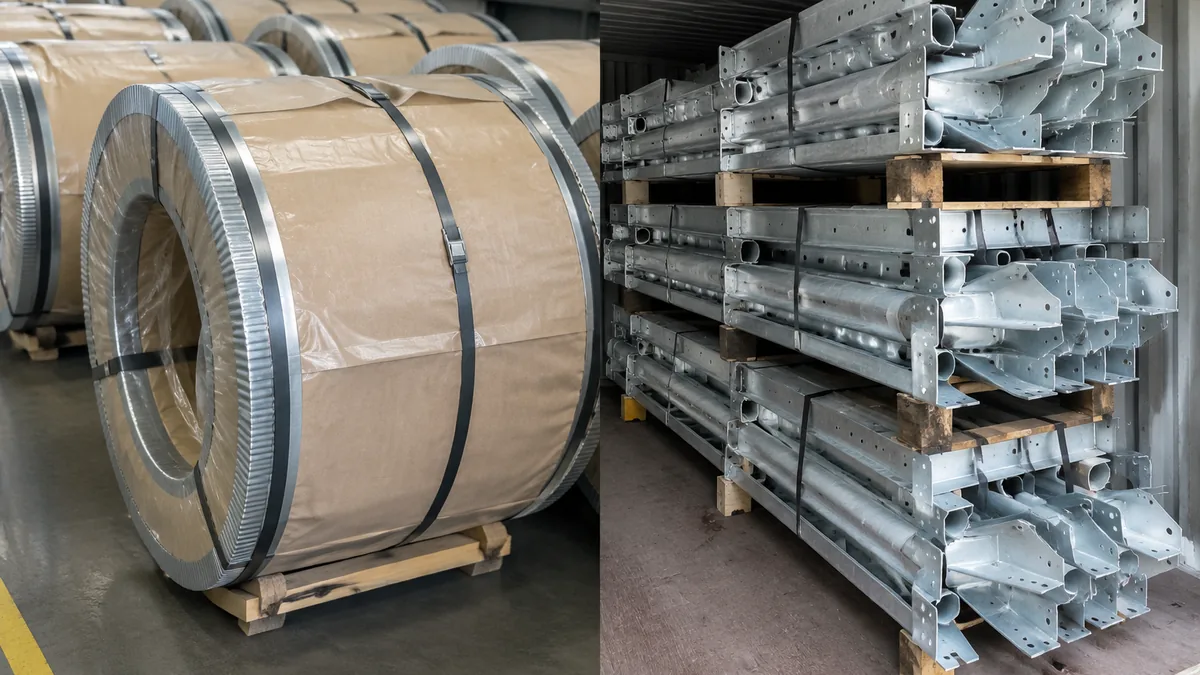
Coil packing for ZM is the same seaworthy stack used for other metallic-coated coils: VCI paper on the steel, waterproof film, inner and outer metal edge rings, corrugated side boards, then at least three circumferential and four radial high-tensile straps. Eye-to-sky on wooden pallets or eye-to-wall in timber cradles with wire-rope lashing. A 20GP still lands near 25–28 MT. Overfilling a slit-coil container to chase that number does not replace VCI.
Fabricated HDG bundles need separators so zinc does not lock to zinc in salt air. Do not strap HDG beams the way you strap black plate. White rust in the bundle is a packing claim, not proof that ISO 1461 failed.
Third-party PSI that only checks thickness and “no red rust” will miss this. Tell SGS, BV, or TUV to read the coating designation on the PO and to photograph coil tags and zinc thickness spots before wrap.
If the mill says ZM120, Z275, and 85 μm HDG are equivalent because all three are zinc, ask for the standard, the mass or the mean thickness, and the product form on the same page as yield. Equivalence talk without those three is a commercial convenience.
RFQ Lines That Split ZM Coil From Batch HDG
Copy this after the tracker bill of materials. Keep fasteners, pile soil, and electrical earthing as their own lines.
Roll-formed members (coil)
- Standard: EN 10346 (ordered edition) +ZM, or ASTM A1046 type named, or JIS G 3323. Do not write only a brand.
- Grade: S350GD or S550GD (or the drawing grade). Not DX51D unless forming strip is truly commercial quality.
- Coating: ZM310 (example — replace with the project mass). Total both sides. Report actual mass on the MTC.
- Thickness x slit width; EN 10143 tolerance class or mill mm band; coil ID 508 or 610 mm.
- Surface: chromate-free passivation or oil; no brand paint story unless a duplex coat was ordered.
- Edge rule: mill’s documented mass versus substrate thickness for punched holes.
- Certificate: EN 10204 3.1 with heat, ladle chemistry, yield/tensile/elongation, coating mass, and coating designation.
- Packing: VCI + film + metal edge rings + 3 circumferential / 4 radial straps; eye-to-sky or eye-to-wall named.
Fabricated members (batch HDG)
- Black steel grade: S355JR / specified plate or section standard; size; weld procedure named.
- Galvanizing: ISO 1461 or ASTM A123, ordered edition. Mean and local-minimum thickness for the actual steel thickness.
- Kettle after all cutting, drilling, and welding. No coating before weld.
- Certificate: EN 10204 3.1 on the steel plus galvanizer report with thickness spots.
- Packing: bundle separators, wrap as required, no wet stacking.
MOQ for coil trials remains 1 × 20GP (25–28 MT) on standard slit sizes. Fabricated HDG may ship mixed with coil only when the packing list splits the two coating families.
Conclusion
ZM coil and batch HDG are two answers to two tracker jobs. Classify the site, split the bill of materials, freeze the standard and the number, then read that number on the MTC before the profiler or the kettle is booked. A 25-year sentence without a class, a form, and a coating designation is not a specification.
Planning an Order or Need a Technical Verification?
If you are sourcing ZM coated structural coil or batch HDG tracker sections and need the coating line checked against your bill of materials:
- Technical quotation: Submit coating designation (ZM or ISO 1461 / ASTM A123), substrate grade, thickness, quantity and destination via our Online RFQ Form. Confirm minimum order, loading plan and dispatch timing in the written offer for the specified material and coating route.
- Quality Assurance: Every order is backed by genuine EN 10204 3.1 Mill Test Certificates with full heat-lot traceability. Third-party inspections (SGS, BV, TUV) are welcomed.
- Urgent Inquiries: Contact our Shandong export desk directly on WhatsApp at +86 151 5311 2221 for instant specification confirmation.