








Introduction
Importing steel angle, channel, and H-beam looks simple until three mills return three different offers. One quotes Chinese HW series by depth and kg/m. Another answers in HEA/HEB language. A third writes ASTM W-shapes and an A36 grade note, then leaves length tolerance, straightness, and packing open. Those prices are not comparable. The first dispute after arrival is usually about the size table, mass basis, or surface condition—not “steel quality” as a slogan.
This guide is for importers, fabricators, project buyers, and traders who source structural sections from China for construction, plant frames, racks, and general fabrication. It is a procurement and acceptance brief, not a design code. Leave member selection and connection design to the project engineer. Use this article to freeze RFQ language so grade, section system, tolerances, documents, and packing can be checked line by line.
Related grade context on the site includes ASTM A36 vs S235JR and Q235 vs ASTM A36. For catalogue entry points, see carbon steel H-beam and matching angle or channel product pages when those forms are ordered.
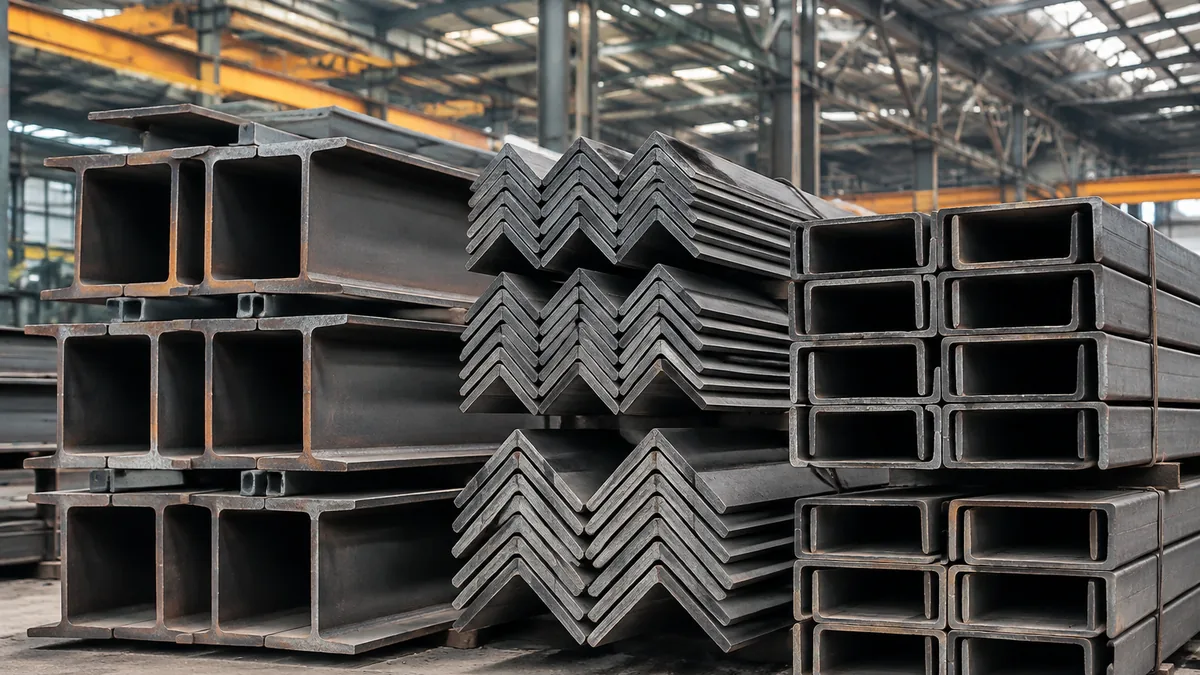
Product Forms Buyers Actually RFQ
Most export packages mix two questions that mills treat separately: what shape and what steel.
| Product form | Common buyer names | What you are buying | Typical use notes |
|---|---|---|---|
| Equal / unequal angle | L-section, angle bar | Two legs, equal or unequal, hot-rolled or sometimes cut/formed | Bracing, frames, towers, secondary members |
| Channel | C-channel, U-channel, PFC (market language) | Web plus two flanges on one side | Purlins, frames, machinery bases, light structures |
| H-beam / wide flange | HEA, HEB, HEM, HW/HM/HN, W-shape | Parallel flanges, wider flange series for columns and main beams | Primary framing, columns, heavy beams |
| I-beam | IPE, IPN, Chinese I-beam, S-shape (US family) | Narrower flange series relative to many H sections | Beams and lighter primary members depending on table |
Do not treat “I-beam” and “H-beam” as free synonyms on an RFQ. Fabricators and designers may use the words loosely, but mill offers follow a named series and a dimension table.
Two Standards Layers: Grade Vs Section Table
A complete structural-section order freezes material grade and geometry/tolerance package.
| Layer | What it controls | Common references buyers write | Buyer trap |
|---|---|---|---|
| Material grade | Chemistry, yield/tensile, impact class where required | ASTM A36, ASTM A572 Grade 50, EN 10025-2 S235JR / S355JR / S355J2, JIS G3101 SS400, GB/T Q235B / Q355B | Writing only “mild steel” or “A36 equivalent” |
| Section dimensions | Nominal depth, flange, thickness, mass table | EN 10365 (European I/H series), Chinese HW/HM/HN or angle/channel tables, ASTM W/S/C/L shapes under general requirements such as ASTM A6 | Mixing HEA200 with a Chinese 200 mm H-beam as if identical |
| Dimensional tolerances | Allowed deviation on height, flange, thickness, mass, straightness, length | EN 10034 for many I/H sections, EN 10056 for angles, ASTM A6 tables for US shapes, matching GB/JIS tolerance standards | Accepting mill stock without stating the tolerance standard |
| Certificate package | Traceability and test report type | MTC, often EN 10204 3.1 for export | Asking for “certificate” without heat identity or test scope |
Grade names are not interchangeable just because yield numbers look close. Cross-reference tables are conversation starters. The purchase order still needs the ordered standard + grade + product form + size designation.
Section Systems That Collide On Quotes
European series (HEA / HEB / HEM / IPE)
European buyers often write HEA, HEB, HEM, or IPE plus a size number. Nominal dimensions and masses are commonly taken from EN 10365 tables. Shape and dimensional tolerances for many I and H sections are discussed under EN 10034. Material is usually ordered under EN 10025 grades such as S235JR, S275JR, or S355J2.
Buyer note: HEA and HEB can share a similar size number while flange and web thickness differ. HEB is the heavier series for the same nominal family. If the drawing says HEB200, do not silently substitute HEA200 to win the price.
US series (W, S, C, L)
US packages often use W (wide flange), S (American standard beam), C (channel), and L (angle) designations. Material is frequently ASTM A36 or ASTM A572 Grade 50 (and other project grades). General requirements for rolled structural shapes, including common mill-report expectations, sit under ASTM A6/A6M.
Buyer note: a W-shape is not a European HEA/HEB. Convert only with engineer-approved tables, not with a sales “close enough” line.
Chinese series and export nicknames
Chinese mills commonly supply Q235B / Q355B (and related grades) in angle, channel, and H-beam forms under Chinese product standards and mill stock lists. Export sales language may say “H-beam 200×200” or quote kg/m from a Chinese HW/HM/HN style table. That can be fine when the PO freezes the Chinese designation. It fails when the drawing is European or US and the offer never states the table.
Japanese / regional JIS language
Some Asian packages still call SS400 under JIS G3101 with section dimensions from the project’s JIS or local fabrication practice. Treat SS400 as a grade family, then lock the actual section table and tolerances separately.
RFQ Checklist: What To Freeze Before The Mill Quotes
Use this list as the minimum commercial specification. Anything left open becomes a free variable in price and acceptance.
| RFQ field | What to write | Why it matters |
|---|---|---|
| Product form | Angle / channel / H-beam / I-beam | Prevents wrong shape family |
| Designation system | EN HEA/HEB/IPE, ASTM W/C/L, Chinese HW/HM/HN, equal angle L a×a×t, etc. | Different mass and geometry tables |
| Exact size list | Full designation per line item | Avoids “200 H-beam” ambiguity |
| Grade + material standard | e.g. S235JR to EN 10025-2, A36 to ASTM A36, Q235B to GB/T | Chemistry and mechanical acceptance |
| Length | Fixed length or range, cut tolerance | Yield and packing density |
| Quantity basis | Pieces, meters, or theoretical tons with kg/m table named | Invoice and claim basis |
| Tolerance package | EN 10034 / EN 10056 / ASTM A6 / named GB/JIS standard | Acceptance measurements |
| Surface / condition | As-rolled, shot-blast, primer, galvanized if ordered | Visual claims and coating cost |
| Straightness / camber | Per ordered standard or tighter project limit | Fit-up on site |
| Marking | Heat / bundle / size marks | Traceability |
| Certificate | EN 10204 3.1 MTC when required; test scope | Document release |
| Packing | Bundle strapping, end protectors, tags, container or bulk | Sea-freight damage |
| Destination / Incoterms | Port and trade term | Logistics cost boundary |
First-Hand Acceptance Checks That Catch Real Disputes
Most section claims are not exotic metallurgy. They are wrong table, wrong mass basis, out-of-tolerance geometry, or document mismatch.
Practical checks buyers and inspectors use before shipment:
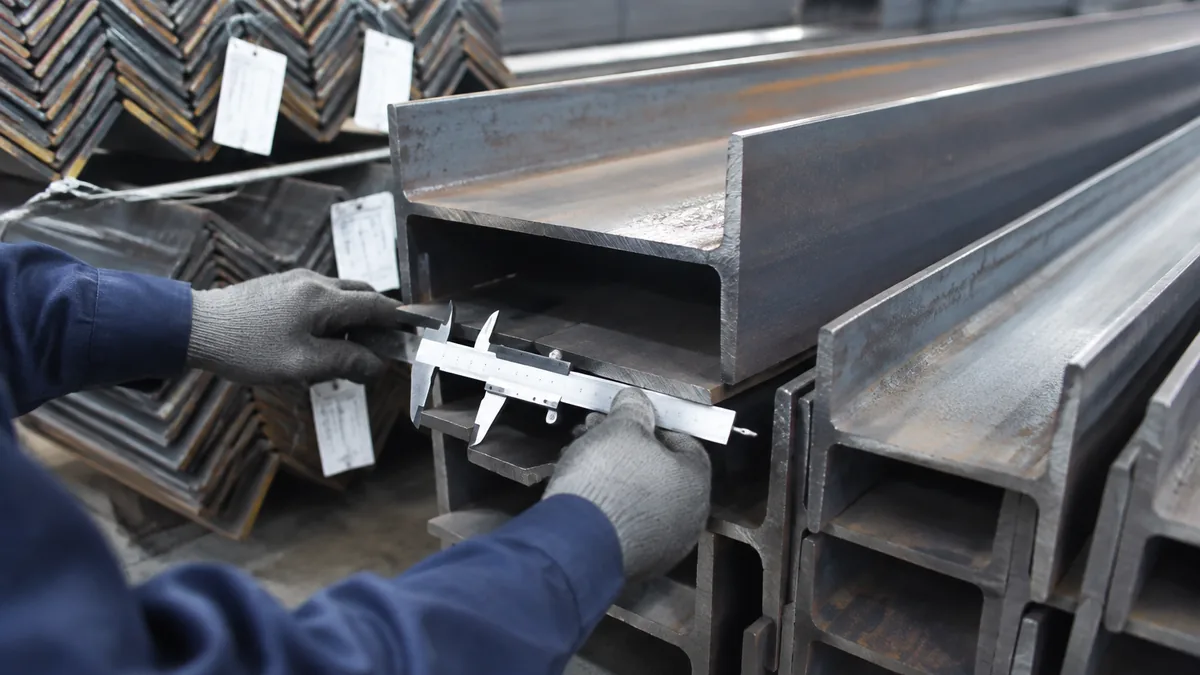
- Match designation to tape measure — Confirm depth, flange width, and thickness against the ordered series table, not against a photo or a generic “200 mm beam” label.
- Check mass language — Agree whether settlement uses theoretical kg/m from a named table, weighed mass, or a contract tolerance on theoretical mass. Two “same size” series can differ by tens of percent in kg/m.
- Length and piece count — Count pieces, measure a sample of lengths, and compare to the packing list. Random short bars destroy fabrication planning.
- Straightness and twist — Sight or measure against the ordered tolerance package. Warped stock may still meet a loose commercial look and fail fit-up.
- Heat identity — Heat marks or tags should match the MTC heat numbers. Bundle tags alone are not enough if heat identity is required.
- Surface and coating — As-rolled scale, rust, primer holidays, or galvanized bare spots should be judged against the PO surface clause, not against social-media photos of bright stock.
- Certificate fields — Grade, standard, size, chemistry, mechanical results, and certificate type such as EN 10204 3.1 should match the PO. Use the site guide on verifying a mill test certificate when heat identity and report fields need a line-by-line check.
Dimensional tolerance language without fake precision
Tolerance tables depend on the edition and product standard you ordered. Public summaries for European practice often discuss:
- Angles (EN 10056 series): leg length, thickness, out-of-squareness, mass, and length deviations by size band.
- I and H sections (EN 10034 context): height, flange width, web/flange thickness, mass, and straightness deviations by size band.
- US shapes (ASTM A6 context): tabulated permitted variations for depth, flange, length, and related geometry.
Treat published summary tables as orientation, not as a substitute for the ordered standard text. If the project needs tighter than standard commercial tolerances, write the tighter limits on the RFQ and get mill confirmation before production.
kg/m, Theoretical Weight, And Invoice Risk
Sections are sold by piece, by meter, or by theoretical ton. Export disputes often start when:
- The mill uses one kg/m table and the buyer’s quantity surveyor uses another.
- HEA is quoted but HEB mass is used in the packing list, or the reverse.
- Length is measured with a different rounding rule than the contract.
Safe commercial practice:
- Name the section table and the kg/m value for each line item on the PI and packing list.
- State whether payment is by theoretical weight, actual weight, or piece count.
- Keep one calculation method from quotation through invoice.
Export Packing For Long Sections
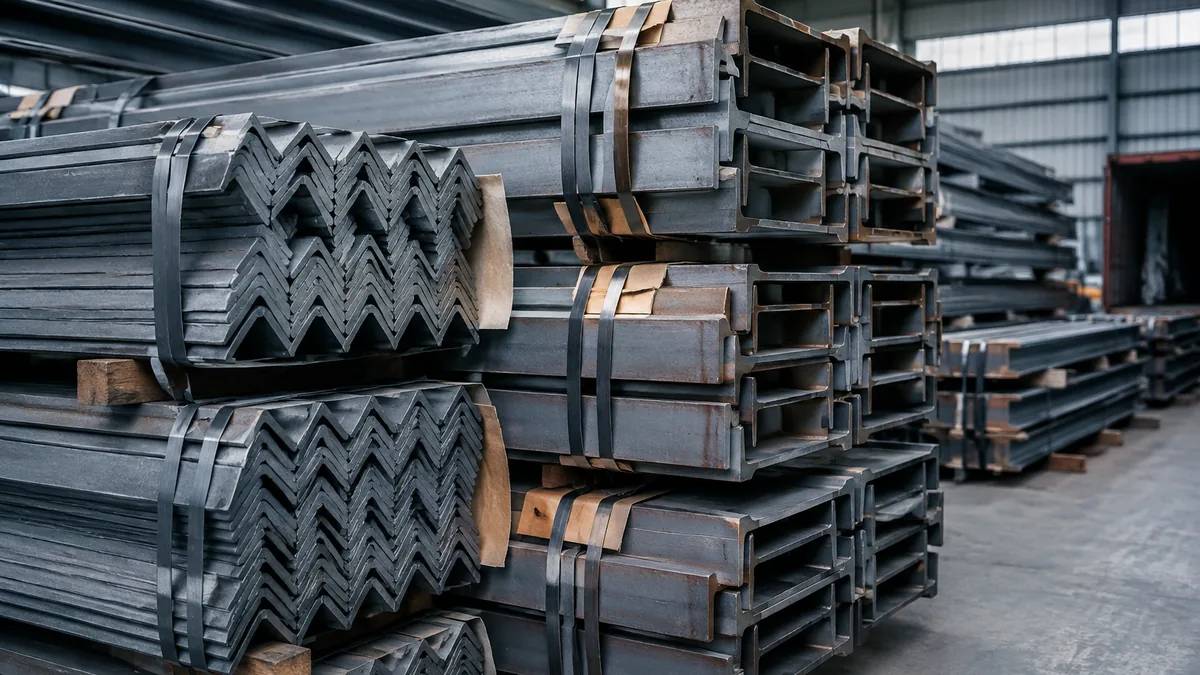
Angles, channels, and beams are long, sharp, and easy to bend at ends during stuffing. A workable packing clause usually covers:
- Bundle size and strap type (and separators where needed to protect paint or galvanized surfaces)
- End protection and tag location readable without unstrapping every bundle
- Container length fit versus bulk / break-bulk for long pieces
- Moisture and rust expectations for sea voyage (oil, wrap, or as-rolled agreement)
- Packing list fields: size, length, pieces, heat/bundle refs, theoretical weight basis
For broader export packing practice, see the steel export packing guide.
Common Buyer Mistakes
| Mistake | What goes wrong | Better RFQ habit |
|---|---|---|
| Writing only “H-beam 200” | Mills pick different series and kg/m | Full designation + table family |
| Mixing grade and shape standards | MTC cannot prove both layers cleanly | Grade standard + section/tolerance standard |
| Substituting HEA for HEB (or W for Chinese H) by sales habit | Capacity and mass wrong | Engineer-approved substitute only |
| Ignoring length tolerance | Fabrication shortfall | Length + cut tolerance on PO |
| “Certificate” without EN 10204 type | Weak claim defense | Order EN 10204 3.1 MTC when needed |
| No packing clause for long bars | End damage and missing tags | Bundle, tag, stuffing method on PO |
Conclusion
Imported steel angle, channel, and H-beam packages succeed when the RFQ freezes the shape series, grade, tolerance package, mass basis, certificate scope, and packing—not when the buyer only names a depth and a mild-steel nickname. Treat European HEA/HEB/IPE, US W/C/L, Chinese H-beam/angle/channel tables, and JIS-linked packages as different commercial languages that may map for design only after engineer review.
If you need a comparable offer for angles, channels, or beams from China, request a quote with the section designation list, material standard and grade, lengths, quantity basis, tolerance standard, destination port, and the MTC / EN 10204 3.1 package you require. Clear specifications produce comparable mill quotations and fewer arrival disputes.